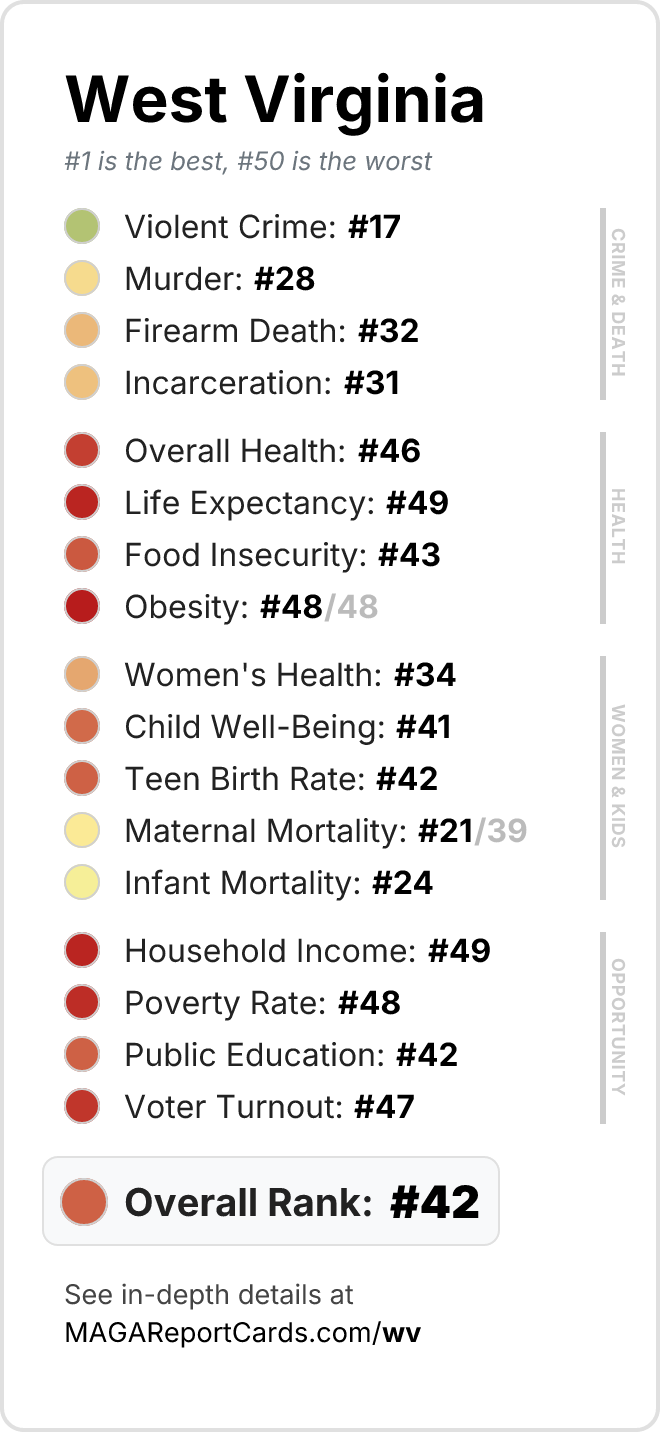
Across the measures we track — health, food, crime, jobs, and more — West Virginia ranks 42nd out of 50 states. That's not an accident of geography or bad luck. It's the water West Virginians are already swimming in: high hunger, high gun deaths, thin paychecks, and a federal workforce that props up whole towns.
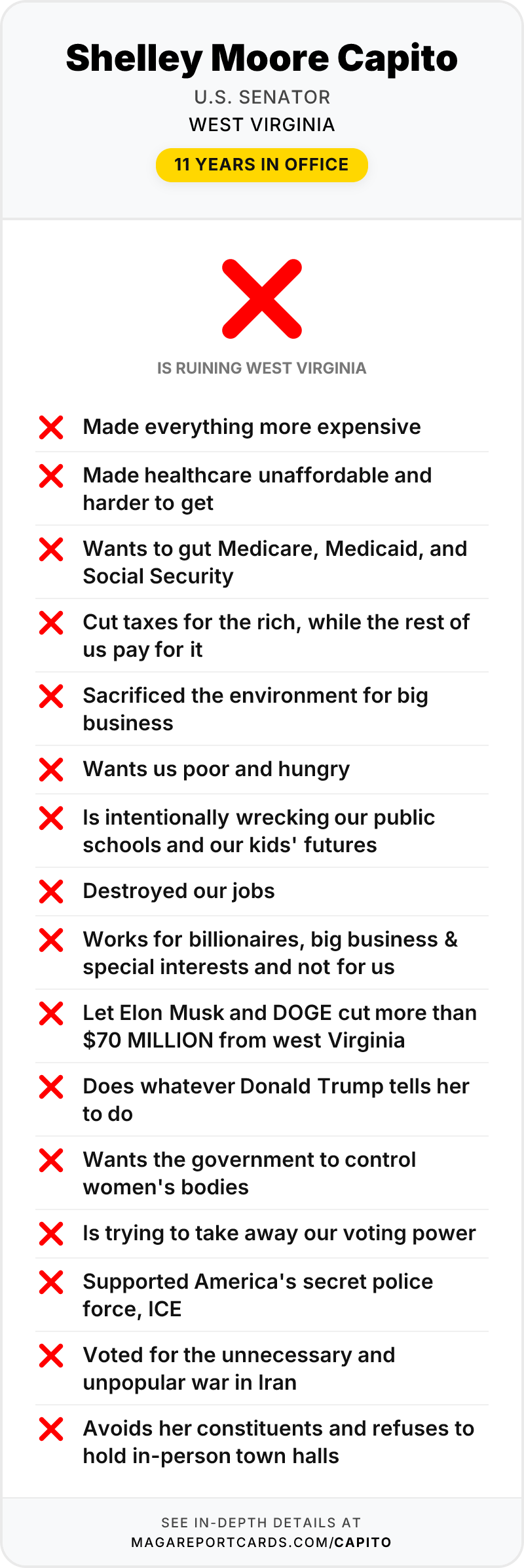
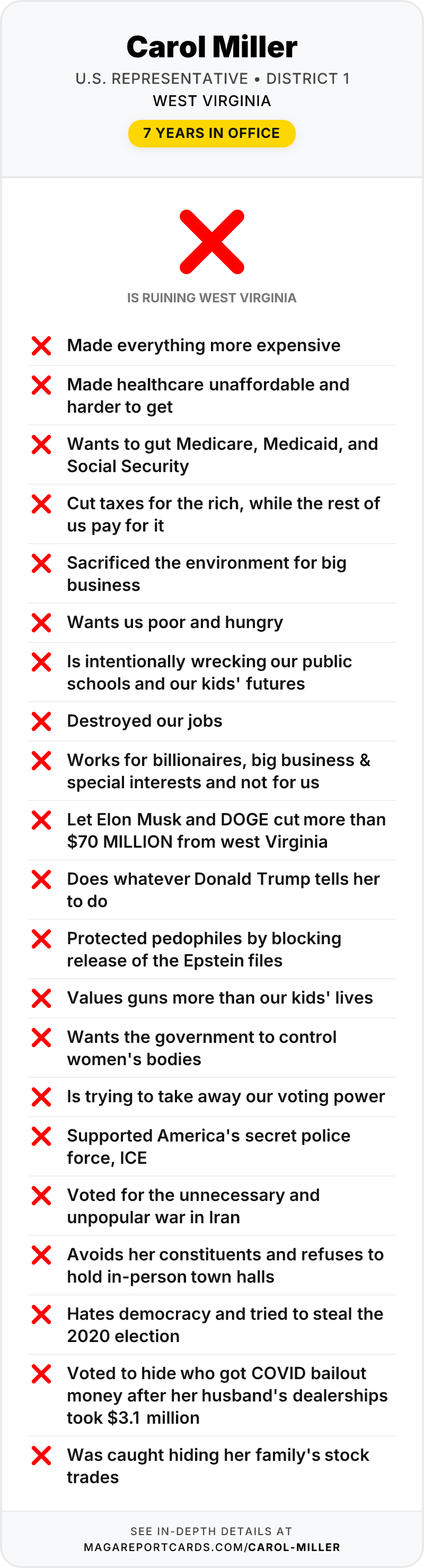
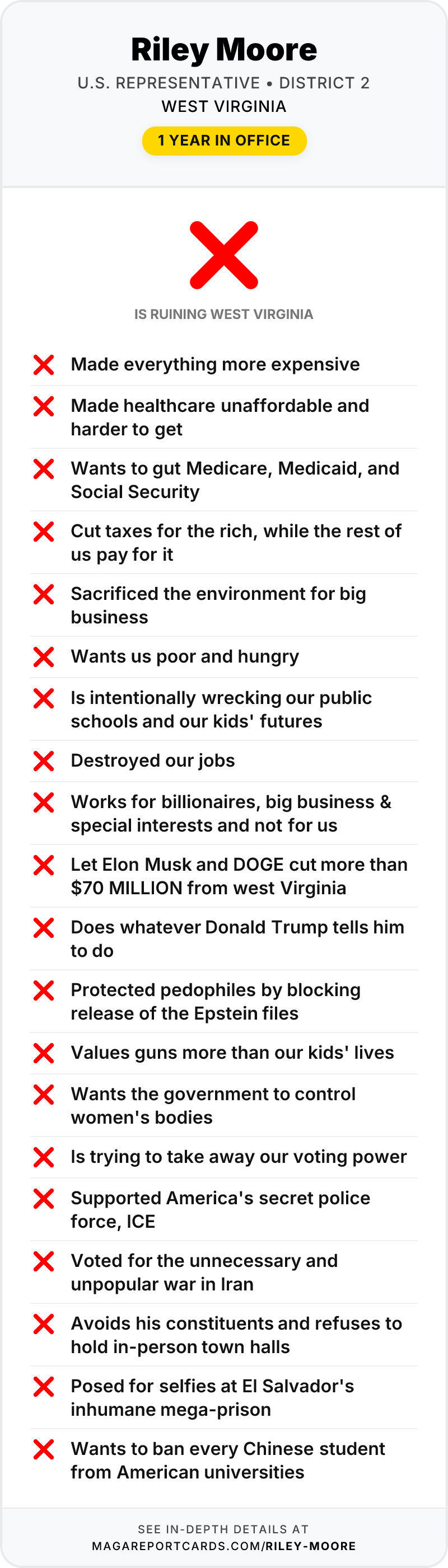
Here's the thing about ranking near the bottom: when Washington cuts, states like ours have the least cushion to absorb it. And the three West Virginia Republicans in Congress who face voters this year — Senator Shelley Moore Capito, Representative Carol Miller, and Representative Riley Moore — didn't vote to soften the blow. They voted to swing the hammer.
Let's walk through the numbers, and then who signed off on them.
55,000 West Virginians set to lose Medicaid
Nearly 55,000 West Virginians are set to lose Medicaid health insurance under Trump's budget bill. All told, KFF projects the law will leave about 60,000 more West Virginians uninsured by 2034 — somewhere between 45,000 and 75,000.
In a state this old, this sick, and this poor, Medicaid isn't a line item — it's how people get their insulin, their cancer screenings, and their nursing-home care. Take it away and the bill doesn't disappear. It moves to the emergency room, to rural hospitals already on the edge, and to families who can't pay.
This didn't happen to West Virginia. It was voted for.
272,800 people on SNAP — in a state where 1 in 4 kids faces hunger
About 272,800 West Virginians rely on SNAP food benefits every month — roughly 15.4% of the population, well above the 12.3% nationwide. And 1 in 4 children in West Virginia faces hunger.
SNAP is the difference between a full plate and an empty one for hundreds of thousands of our neighbors. The same budget bill that cuts Medicaid also squeezes food assistance — shifting costs onto a state that already can't afford them, and onto kids who didn't get a vote.
$330 million in grants and 2,200 federal jobs gone to DOGE
West Virginia has roughly 22,900 federal workers — about 3.2% of the state's entire non-farm workforce, which makes the federal government a bigger employer here than coal mining. Those aren't faceless bureaucrats. They're mine-safety researchers, Treasury clerks, and park rangers who live here, shop here, and pay taxes here.
By August 2025, the West Virginia Center on Budget and Policy had counted $330 million in federal grants and 400 federal jobs cut by DOGE. By the end of the year, it put the state's lost federal jobs at 2,200. The hardest-hit agencies, by its count, were the Bureau of the Fiscal Service in Parkersburg, NIOSH in Morgantown (the agency that literally studies black lung), the Job Corps Center in Charleston, and National Park Service staff at the New River Gorge. DOGE brags about the roughly $70 million it "saved" by cutting from West Virginia — but the state lost $330 million in grants alone, before you count the wages and services that money would never have replaced.
On top of that, there were 95,000 layoffs and discharges in West Virginia in 2025. In a state this size, that's a wound that doesn't close fast.
281 West Virginians died from guns in one year
In 2024, 281 West Virginians died from gun-related injuries — 15.3 per 100,000 people, a rate 19.5% higher than the country's.
You'd think a delegation that talks about protecting West Virginia families would treat that as an emergency. Instead, when Congress passed its first major gun-safety law in decades in June 2022, Carol Miller voted no. (Capito voted yes; Riley Moore was not yet in Congress.)
Who voted for this
The Medicaid cuts and the SNAP squeeze didn't pass themselves. They passed because West Virginia's own representatives in Washington voted yes:
- Shelley Moore Capito — U.S. Senator
- Carol Miller — U.S. Representative
- Riley Moore — U.S. Representative
And when West Virginians tried to ask them about it face to face? They couldn't find them. All three have dodged public town halls, holding screened events or none at all while the cuts landed back home.
The choice in 2026
West Virginia doesn't rank 42nd because its people don't work hard. It ranks 42nd because for years it's been treated as a place to cut, not a place to invest — and the people we sent to Washington to fight for us have been holding the door open for the cuts instead.
In 2026, that's on the ballot. The numbers on this page are the record. The names above are the ones who voted for it. West Virginians get to decide whether that's the representation they keep.