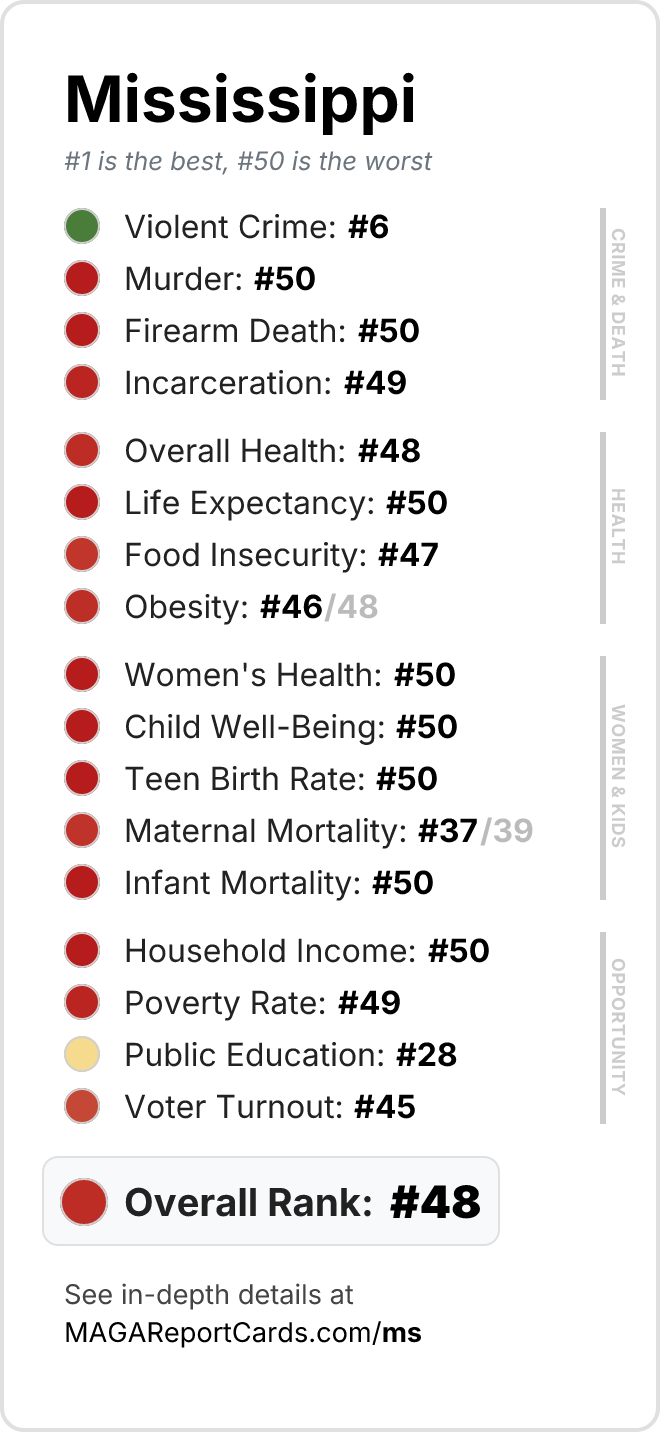
Mississippi works hard and takes care of its own. Faith, family, and the folks down the road still mean something here. But on the everyday things that decide whether a family gets by — health coverage, food on the table, a paycheck, safe streets — the numbers tell a hard story that no amount of pride can talk around.
When we add up the measures we track across all 50 states — health, crime, food insecurity, education, and more — Mississippi ranks 48th out of 50. That's the ground Mississippians are standing on before Washington lifts a finger. The problem is what Washington just did on top of it.
Let's be straight about what that ranking is and isn't. It measures where the state already sits. It doesn't prove any one politician put it there. But the votes below aren't a ranking — they're a record. Mississippi's Republicans in Congress voted for a budget that takes one of the poorest, sickest, hungriest states in the country and makes the very things Mississippians struggle with worse. Here's what that costs, and here's who voted for it.
Mississippi loses billions in Medicaid — and tens of thousands lose coverage
Start with the biggest one. Under Trump's budget bill, Mississippi stands to lose an estimated $3 billion in federal Medicaid funds over the next decade, by KFF's estimate ($2.3 billion to $3.8 billion). KFF projects the law will leave about 37,000 more Mississippians uninsured by 2034 — and about 110,000 once you add the enhanced Affordable Care Act tax credits Congress let expire.
That's not a small program in Mississippi — it's the backbone of the whole system. On average 714,600 people, or 24.2% of the state's population, were on Medicaid in 2024. Nearly one in four Mississippians. Pull billions out of that, and it isn't only the newly uninsured who lose. In a state this rural, the local hospital is often the only one for an hour in any direction. When it cuts services or closes, everybody in that county drives farther for the ER, waits longer for a bed, and pays more. Faith leaders rallied outside Hyde-Smith's Jackson office in July 2025 to sound the alarm about what these cuts do to the most vulnerable.
Every Mississippi Republican listed at the bottom of this post voted for the bill that does this.
1 in 4 Mississippi kids faces hunger — and they cut food aid anyway
Here in Mississippi, 1 in 4 kids faces hunger. About 384,800 Mississippians received SNAP benefits in 2024 — more than two-thirds of them in families with children, more than 41% in families with older adults or people with disabilities — along with 9,000 Mississippi veterans.
SNAP is how a lot of those hungry kids eat. So when Congress votes to cut it and shift the cost onto states, the question isn't abstract — it's whether a mom in the Delta can still cover the week's groceries. The same budget bill that guts Medicaid also squeezes food assistance. The two lifelines Mississippians lean on most, cut in the same stroke.
Tariffs are hitting Mississippi's factories and farms
Cost of living is the thing people feel every week, and Mississippi is getting squeezed. Trump's tariffs could hit Mississippians directly through higher prices, and the state's manufacturers are wary of the steel and aluminum tariffs that raise costs for metal fabricators who buy their inputs abroad — costs that get passed on to their customers.
That's a tax on Mississippi's kitchen tables and Mississippi's shop floors at the same time. The delegation below hasn't done anything to stop it.
DOGE torched Mississippi jobs and cut the culture budget
Mississippi saw 152,000 layoffs and discharges in 2025. Into that, DOGE went hunting for a headline number — claiming more than $300 million in "savings" from the state. In one of the neediest states in the country, those cuts landed with extra weight.
One concrete example: DOGE cut federal funding for the Mississippi Humanities Council, which gets about 70% of its funding from the federal government — the group behind book clubs, museums, historic markers and history programs across the state. By April 2025, nearly $400 million in federal funding had been frozen or was being frozen across Mississippi, and state lawmakers heading into a budget special session were left deciding whether to replace it with state money. Mississippi's Republicans in Congress didn't slow any of it down. They cheered it on.
Mississippi has the worst gun death rate in America
Mississippi had the highest gun death rate and the highest gun homicide rate in the country in 2024. Not high — the highest. More Mississippi families bury someone to gun violence, per person, than in any other state.
Yet the delegation below has stood against even the most modest steps. Guest and Kelly voted against universal background checks in 2021 and a federal red-flag law in 2022, and Hyde-Smith voted against the 2022 bipartisan gun-safety law. (Ezell was not yet in Congress.) On the one issue where "thoughts and prayers" has worn thinnest, and where Mississippi is hurting worst of all, these members keep voting for nothing.
The members who voted for this
These are Mississippi's Republicans in Congress who are on the ballot this year — the people who cast the federal votes behind the numbers above. (Sen. Roger Wicker, who isn't, voted for the bill too.) And when Mississippians called, emailed, and protested to raise the alarm about this budget, they got, as Mississippi Today's Adam Ganucheau put it, a voicemail box or a few words with a low-level staffer:
What happens next is up to Mississippi
None of this is fixed in stone. Mississippi ranks 48th today, but rankings move — and votes move them. Medicaid can be protected or gutted. Food aid can be defended or slashed. Factory jobs and the price of groceries can be steadied or squeezed for a press release. Every one of those is a choice, and in 2026 it's Mississippi's choice to make.
The people above have already told you how they'll choose. They've been telling you with every vote. The only question left is whether Mississippi keeps sending them back to cast the next one.