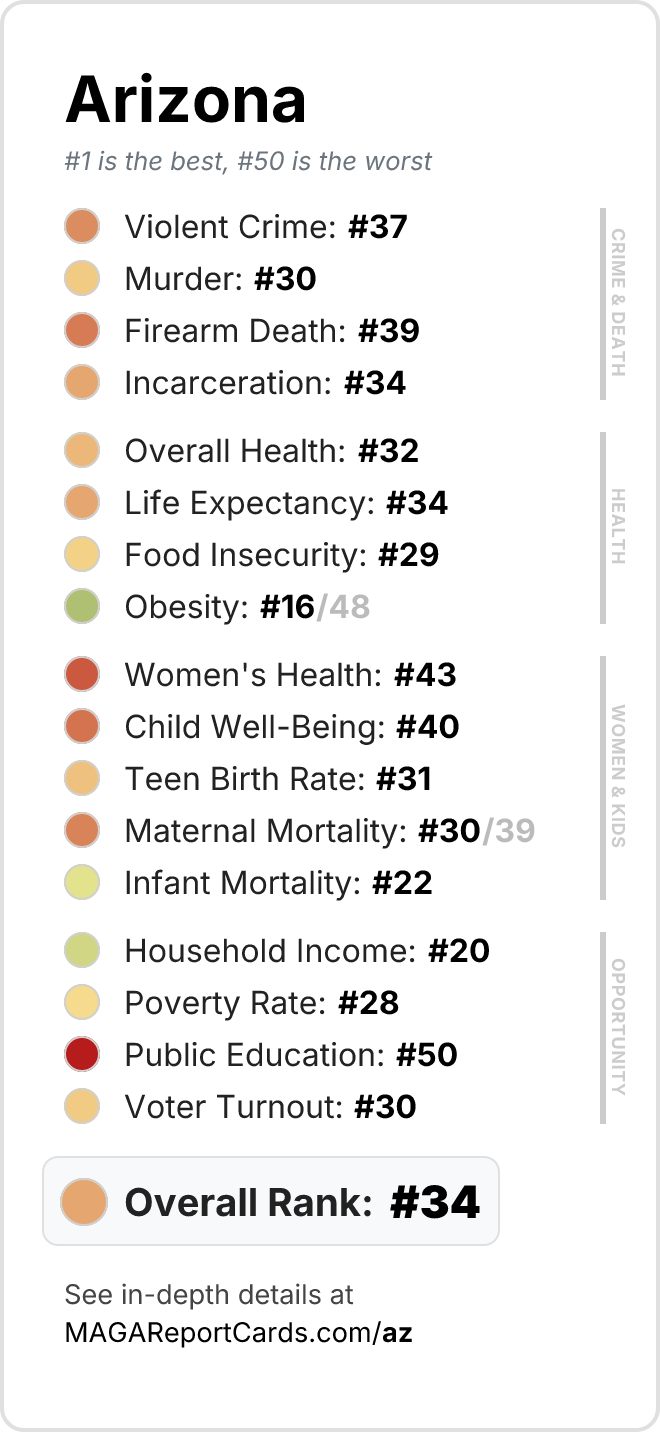
Across the measures we track — health, food, crime, jobs, and more — Arizona ranks 34th out of 50 states. Not last, but firmly in the bottom half. That's the ground Arizonans are already standing on: high hunger, gun deaths well above the national average, and rising prices squeezing every household in the state.
Here's what matters about that starting point: when Washington cuts, states in the bottom half have less room to absorb the hit. And Arizona's six Republicans in Congress — Andy Biggs, David Schweikert, Paul Gosar, Eli Crane, Juan Ciscomani, and Abraham Hamadeh — didn't vote to cushion Arizona. They voted for the budget bill and the cuts that make these numbers worse.
Let's walk through the figures, and then who signed off on them.
More than 300,000 Arizonans could lose their health coverage
More than 300,000 Arizonans could lose access to federally subsidized health coverage under Trump's budget bill, according to projections from the Joint Economic Committee.
For a state already this far down on health outcomes, that's not a rounding error. It's insulin that doesn't get filled, cancer screenings that get skipped, and rural clinics that lose the patients who keep their doors open. When coverage disappears, the cost doesn't. It moves to the emergency room and to families who can't pay.
This didn't happen to Arizona. It was voted for.
889,600 people on SNAP — and Arizona already leads the nation in the drop
In fiscal 2025, about 889,600 Arizonans relied on SNAP food benefits every month — roughly 11.7% of the state. Here in Arizona, 1 in 5 kids faces hunger.
Then the budget bill hit. Arizona's food stamp rolls have shrunk by more than 400,000 people — including 180,000 children, and a spokesman for the governor blamed part of that on the bill's new requirements. Arizona has posted the highest percentage reduction in food-stamp recipients of any state in the country. That's not a projection or a warning. It already happened — to the family down the street and to kids who never got a vote.
$470 million in DOGE cuts — and a wildfire season Arizona can't afford
DOGE brags about the roughly $470 million it "saved" by cutting from Arizona. But look at what that number actually bought.
The Forest Service treated 35% fewer acres for hazardous wildfire fuels nationwide in 2025 — with Arizona's fuel-treatment acreage dropping about 11%, according to the Center for Western Priorities, which blames the mass firings at the agency, combined with an especially dry winter. In a state that watches the forecast every summer and holds its breath, thinning less brush isn't a paperwork savings. It's a bigger, hotter fire waiting to happen — and the homes, watersheds, and firefighters that pay for it.
That's the trade Arizona got: a headline "savings" number in Washington, and less protection standing between the state and the next catastrophic burn. On top of it, there were about 388,000 layoffs and discharges in Arizona in 2025.
A hidden tax on Arizona families
While prices climbed, four of Arizona's Republicans in Congress — Biggs, Crane, Hamadeh and Ciscomani — took the stage to defend Trump's tariffs, which the Arizona Center for Economic Progress calls a hidden tax on Arizona families — warning that Trump's campaign tariff plan, fully realized, could cost the average American household an extra $2,600 per year. A 21% tariff on Mexican tomatoes alone could hit Arizona hard: Nogales is one of the top entry points for tomatoes into the U.S., and research has put the cost of higher tomato tariffs at more than $3 billion in economic losses in the state.
So the same delegation that talks about the cost of living voted for a health-care cut and a food-benefit cut, and defends a tariff regime that works as a hidden tax on every household. Cutting your coverage and raising your grocery bill at the same time isn't fighting for Arizona. It's the opposite.
16.9 gun deaths per 100,000 — 32% above the U.S. rate
Arizona's gun-death rate is 16.9 per 100,000 people, 32% higher than the national rate. You'd think a delegation that talks about protecting Arizona families would treat that as an emergency. Instead, our members in Congress have consistently blocked even the most basic steps to keep guns out of the wrong hands.
Who voted for this
The Medicaid cuts and the SNAP squeeze didn't pass themselves. They passed because Arizona's own Republicans in Washington voted yes. All six currently serve in the U.S. House — and Biggs is now asking Arizonans to make him governor, after beating Schweikert in the July 21 primary:
- Andy Biggs — U.S. Representative (AZ-05), running for Governor
- David Schweikert — U.S. Representative (AZ-01), lost the July 21 primary for Governor
- Paul Gosar — U.S. Representative (AZ-09)
- Eli Crane — U.S. Representative (AZ-02)
- Juan Ciscomani — U.S. Representative (AZ-06)
- Abraham Hamadeh — U.S. Representative (AZ-08)
And it's not just the budget. ICE arrests more than tripled in Arizona in fiscal 2025 — over 6,000 arrests — as street operations spread into neighborhoods and workplaces, with families arrested outside grocery stores and on the way to doctor's appointments.
The choice in 2026
Arizona doesn't rank 34th because its people don't work hard. It ranks where it does because for too long it's been treated as a place to cut — and the people we sent to Washington kept holding the door open for the cuts instead of standing in the way.
In 2026, that's on the ballot: six House seats, and one of these same members asking for a promotion to the governor's office. The numbers on this page are the record. The names above are the ones who voted for it. Arizonans get to decide whether that's the representation they keep.