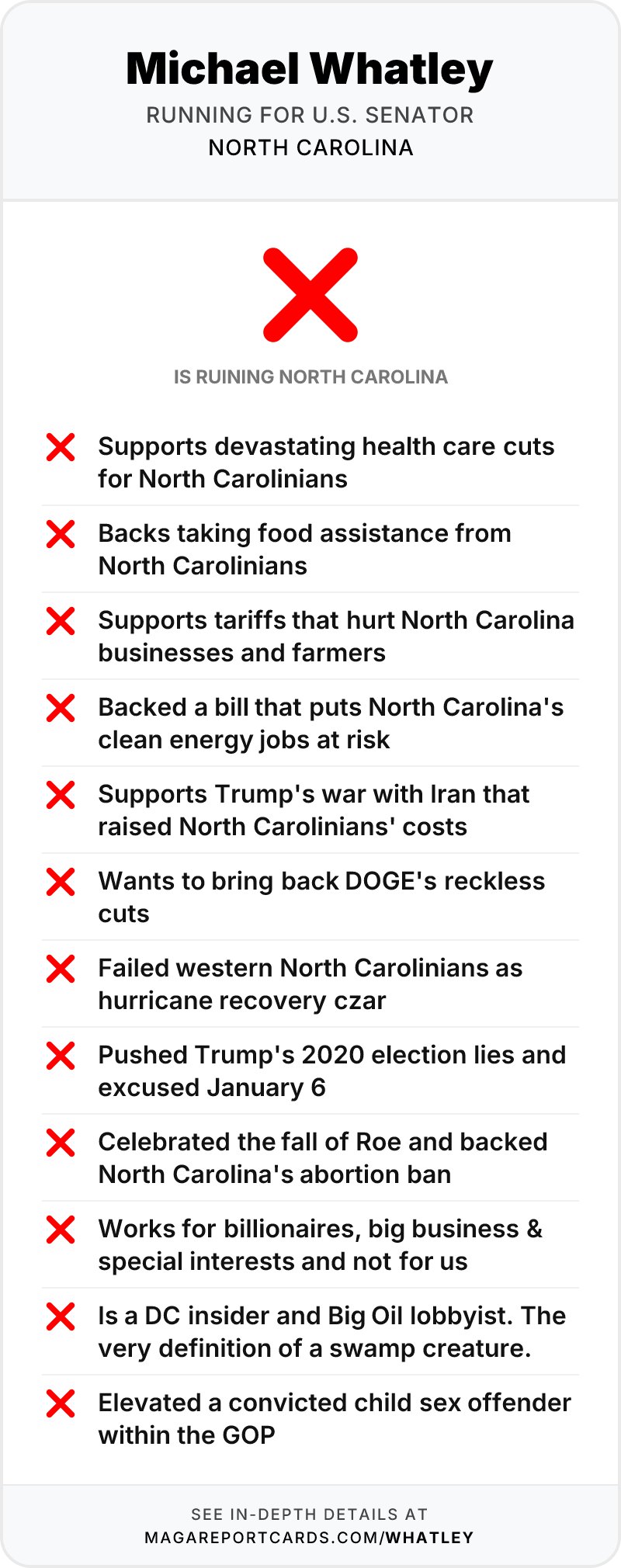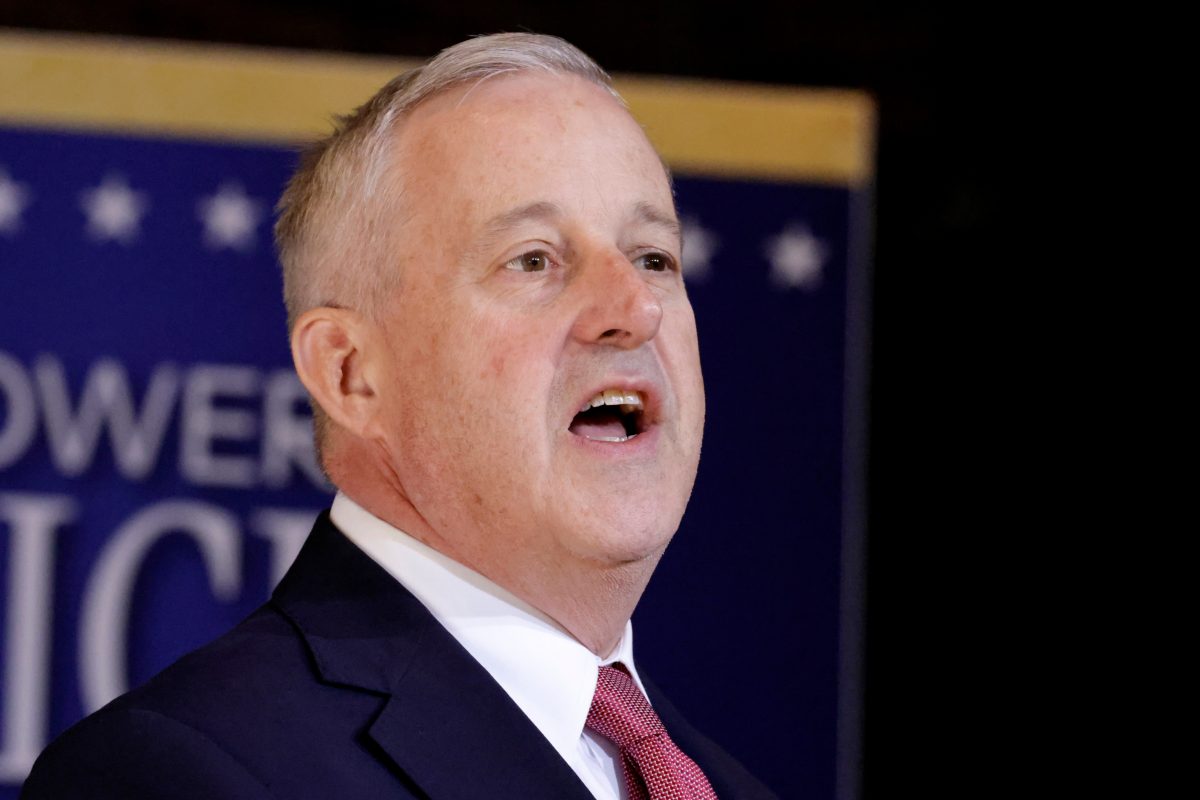
In January 2025, Donald Trump gave Michael Whatley a job: recovery czar for western North Carolina, coordinating the response after Hurricane Helene tore the region apart.
The job leans on FEMA. The recovery he was named to coordinate relies in part on federal disaster assistance programs administered through it. That is the machinery the czar was appointed to help steer.
Now there's audio of what Whatley says he told the president about that agency.
"I've suggested the president do that"
At a May 20 event in Brunswick County, Whatley — by then the Republican nominee for U.S. Senate — took a question from a woman in the audience.
Woman: "Can we get rid of FEMA?"
Whatley: "I've suggested the president do that."
The audio was obtained by The Assembly and published by Cardinal & Pine.
He went on to describe what he'd want instead: block grants to the states, and a new "Office of Disaster Management" folded under the Secretary of Homeland Security.
Read that answer again with the calendar in mind. He wasn't a candidate reflecting on federal policy from the outside. He was, at that moment, the person the White House had put in charge of a FEMA-dependent disaster recovery — telling a crowd he'd personally recommended the agency be eliminated.
What western North Carolina was living through
This is not an abstract governing-philosophy debate. It landed on people who had lost their houses.
While Whatley held the czar title, residents said he simply wasn't there. The Smoky Mountain News reported that Helene victims were still waiting for Whatley months into the recovery. The criticism got loud enough that more than 120 people signed a letter demanding his removal, and his response was to blame Democrats.
Meanwhile the money moved slowly. Residents said federal funding was bottlenecked, and FEMA staff were cut — the same agency he'd suggested abolishing, losing the people who process claims.
And when ProPublica reported that Homeland Security Secretary Kristi Noem had fast-tracked more than $11 million for a Florida tourist pier after one of her donors intervened while, as North Carolina Sen. Ted Budd put it, Helene money was "stacking up on her desk waiting for her signature," Whatley was caught on camera three days later avoiding a disaster-relief question.
So the picture is consistent. Absent from the recovery. Quiet when his own region got moved to the back of the line. And, by his own account, telling the president to scrap the agency doing the work.
"Block grants" is not a neutral swap
Whatley's alternative deserves a plain-English translation, because "block grants to the states" sounds tidy.
A block grant is a fixed pot of money handed to a state. FEMA assistance is not fixed — it scales to the size of the disaster. That difference is the entire point of having a national disaster agency: a storm that would bankrupt one state gets absorbed by all fifty.
Helene was exactly the kind of event that breaks a state budget. Swapping open-ended federal disaster response for a capped state grant means that when the next Helene hits, the ceiling is whatever was budgeted before anyone knew the storm was coming.
Whatley proposed this while standing in a state that had just needed the uncapped version.
The thing he never said out loud
Here's what makes this a story rather than a policy disagreement.
On the tape, Whatley pointed to the FEMA Review Council report he had signed two weeks earlier: "I wrote that into the recommendations." But that 75-page report, The Assembly found, "calls for major structural changes" and "doesn't advocate for dissolving the agency." The position surfaced because someone recorded him answering a question at a county event and a news organization got the tape.
North Carolinians who spent 2025 refreshing their FEMA claim status were entitled to know that the man Trump put in charge of their recovery had recommended dismantling it. They found out over a year later, from a recording.
Whatley is now asking those same voters to send him to the Senate, where FEMA's budget and authority are actually written.
Western North Carolina is still owed billions. We deserve better.
Source
Reporting by Cardinal & Pine (July 30, 2026) and The Assembly, based on audio obtained by The Assembly, with recovery coverage from Smoky Mountain News, WLOS, and NOTUS.