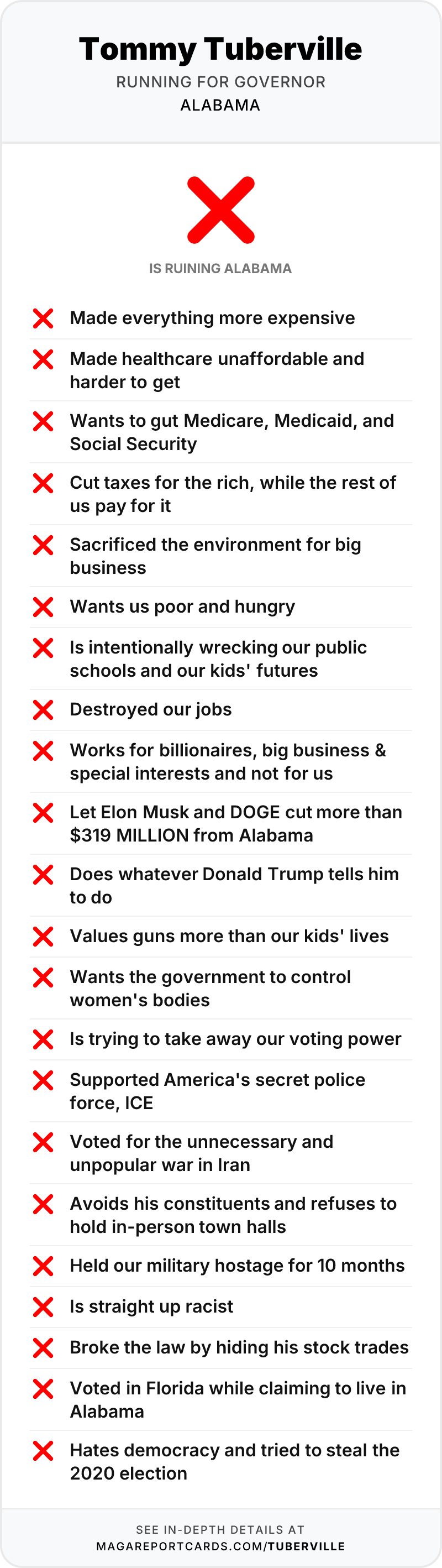
On Wednesday, July 29, Tommy Tuberville stood on the floor of the United States Senate and told Americans that the retirement program they've paid into their whole working lives is a fraud.
He called Social Security a "government-approved Ponzi scheme."
He said "it is almost like the system was set up to fail from the get-go."
Here's the part he left out of the speech: he has collected from it.
Income tax records show Tuberville has received nearly $100,000 from Social Security over three years — about $93,000 — according to Lagniappe, the Mobile-based newspaper that reviewed the records. That money came in on top of his U.S. Senate salary and his other retirement benefits.
Tuberville drew those benefits in the 2021, 2022 and 2023 tax years, and none in 2024, according to the same records; Lagniappe reports it is unclear whether he stopped. So the senator now telling Alabama seniors that the program keeping their lights on is a scam spent his first three years in office cashing its checks.
What a "Ponzi scheme" actually accuses people of
Words matter here, and Tuberville picked a big one.
A Ponzi scheme is a crime. It's fraud — a con where early investors get paid with money taken from later victims, and someone eventually goes to prison. Bernie Madoff ran a Ponzi scheme.
When a sitting U.S. senator uses that phrase about Social Security on the Senate floor, he is telling every retiree in Alabama that the check in their mailbox is the product of a swindle, and telling every working person that the money coming out of their paycheck is being stolen.
Tuberville put the same message on X: "The D.C. swamp doesn't want to talk about Social Security, but here's the truth: It was set up to fail from the beginning."
But he didn't refuse the money. He didn't decline to enroll. He took it, and now he calls it a scam.
Lagniappe asked his campaign about exactly that — how he squares collecting benefits with calling the program fraudulent. The campaign did not acknowledge the questions.
His own campaign is how we know
The most remarkable part of this story is how the records got out.
Tuberville's gubernatorial campaign volunteered his tax returns on June 1, in its response to a residency challenge — handing them to the primary opponent who had filed it. But the campaign botched the redactions. Each page still carried a visible PDF417 barcode, the dense square barcode that tax software prints on returns.
Those barcodes aren't decorative. When scanned, they render the data from the entire tax return: Social Security numbers, driver's license information, wages, deductions, investment earnings. Everything the black boxes were supposed to hide was sitting right there in machine-readable form.
Lagniappe scanned them and reported what was inside.
Nobody hacked anything. Tuberville's own campaign handed over the documents, and his own campaign failed to redact them properly.
Then he threatened the newspaper
Tuberville's response to that first round of reporting was not to explain himself. It was to try to make it disappear.
In June, his campaign's attorney sent Lagniappe a cease-and-desist letter demanding its articles be taken down. The letter accused the outlet of unlawfully accessing the information, said the publication violated federal and state law, and argued the reporting was not protected by the First Amendment.
That last claim is a striking thing for a candidate for governor to put in writing about a newspaper covering his finances.
Lagniappe didn't fold. Co-publisher Rob Holbert called the letter "full of falsehoods and assumptions," said the paper "did absolutely nothing illegal" in verifying data that the Tuberville campaign "failed to redact properly," and said the reporting was "absolutely protected by the First Amendment."
This wasn't reported only by outlets unfriendly to Tuberville. Two conservative Alabama news organizations covered the cease-and-desist as well — Yellowhammer News and 1819 News.
This is a pattern, not a slip
The same trove of tax records already produced one broken promise.
When Tuberville ran for the Senate in 2020, he pledged to donate his entire Senate salary to Alabama veterans. We wrote about that promise here — his own tax records and his foundation show no evidence it happened, across six years and more than $1 million in pay.
Now the same records show him drawing from a program he publicly calls a criminal fraud.
Put the two together and a shape emerges. Tuberville is comfortable saying whatever plays well — I'll give my salary to veterans, Social Security is a Ponzi scheme — while his actual financial life runs in the opposite direction. He kept the salary. He took the Social Security. And when a reporter checks the paperwork, the lawyers show up.
Why this matters for Alabama
Tuberville is not just a senator anymore. He's running to be Governor of Alabama.
For a lot of older Alabamians, Social Security isn't a bonus on top of a pension and a portfolio. It's the floor — the money that covers rent, groceries, and medicine. Tuberville knows what that money means to the people whose votes he's asking for, because he has received it himself.
A politician who describes that floor as a criminal fraud is not making a narrow argument about trust-fund accounting. He's building the case for taking a hammer to it. And the people who would feel that hammer are the same people who just learned their senator collected about $93,000 from the program while calling it a scam on the Senate floor.
If Social Security is really a fraud, Tuberville is welcome to give the money back.
Asked how he squares the two, his campaign didn't answer. We deserve better.
Source
Reporting by Scott Johnson for Lagniappe (July 30, 2026). Photo: Lagniappe.