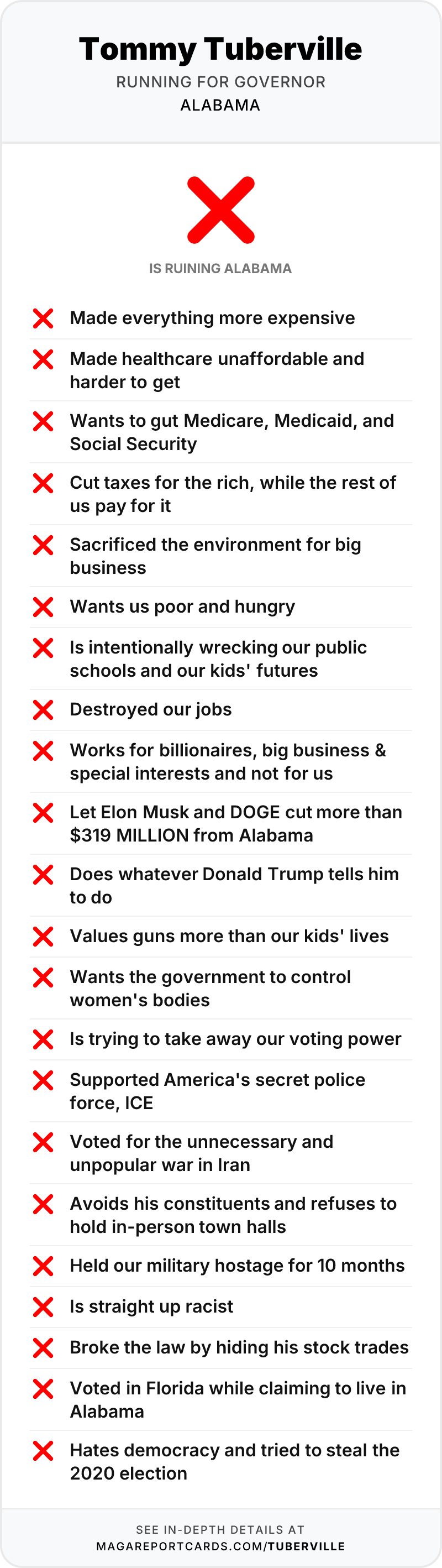
Tommy Tuberville has been Alabama's U.S. Senator since 2021 — five years. Before that he was a football coach with no experience in government. Now he wants a promotion: he's running for Governor of Alabama in 2026. Before Alabama hands him that job, here are three things worth knowing about how he's done this one.
1. He talks about Americans like they're vermin
Our leaders are supposed to represent all of us. Here's a sample of how Tuberville has talked while representing Alabama in the United States Senate.
On white nationalists serving in the military, he disputed that they are racist by definition, insisting a white nationalist is just "an American." Asked again the next morning, the furthest he would go was a conditional: "If the Democrats say that a white nationalist, in which they said, well, that's the definition, then I'm totally against white nationalists."
On Muslims, he has declared that "Islam is not a religion. It's a cult" claimed that "Islamists aren't here to assimilate. They're here to conquer," and posted that mass migration of "Islamic extremists destroyed Europe." That conduct got him named to a civil rights group's list of anti-Muslim extremists.
And asked whether Trump should cut off funding to "sanctuary" cities, he called the people in them "inner-city rats" who "live off the federal government," adding: "it's time we find these rats and we send them back home."
That last one matters extra right now. He's asking to be governor of a state whose cities are full of the people he's describing.
2. He votes against Alabama's own clean-energy jobs
Tuberville has a 0% score from the League of Conservation Voters for 2025 — zero pro-environment votes out of 34 scored in the Senate — and a 3% lifetime score. Five years in the Senate, and he has voted the pro-environment way about three times in a hundred.
This isn't just about abstract climate rules. Alabama has built a real solar manufacturing industry — First Solar's plant in Lawrence County, Runergy in Madison County, OMCO Solar in Limestone and Talladega counties. When the Senate took up the bill stripping out clean-energy incentives, the group Energy Alabama named Tuberville directly: he and Katie Britt "have repeatedly expressed their public support for this bill and have not attempted to amend problematic provisions in any meaningful way." The group warned it would "destroy good paying jobs in energy efficiency and solar installation" and threaten "major solar developments in our rural counties."
Meanwhile, the EPA is being dismantled — including no longer putting a dollar value on the lives saved when it writes rules for fine-particle and ozone pollution. We pay for that in asthma, cancer, and early deaths. Tuberville's voting record says he's fine with it.
3. He broke the stock-disclosure law 132 times in one year
Members of Congress vote on things that move markets. That's why the STOCK Act requires them to publicly disclose their stock trades within 45 days — so the rest of us can see whether they're cashing in on their own votes.
In his very first year in office, Tuberville disclosed 132 stock trades late — weeks or months past the deadline. The transactions totaled at least $894,000. This wasn't one form that slipped. It was 132 violations, over and over, for months.
CNBC, which first reported the late filings, put the trades from January through May alone at $894,000 to more than $3.5 million — including the awkward detail that this loud critic of China was selling stock options in Alibaba, China's leading e-commerce company, while breaking the disclosure law meant to keep his trading honest.
If you or I broke a federal financial disclosure law 132 times, we would not be describing it as a paperwork issue.
What it all adds up to
These aren't three unrelated stumbles. They're three versions of the same thing: a senator who thinks the rules — of basic decency, of representing the people in your own state, of the financial disclosure law he's sworn to follow — apply to other people.
Five years is long enough to learn the job. He's had it. Now he's asking Alabama for a bigger one, and in 2026 Alabama gets to decide whether this is the record it wants running the state.