The Boundary Waters Canoe Area Wilderness is one of the most beautiful, untouched places in America — a million acres of clean lakes and forest in northern Minnesota that draw families, hunters, anglers, and paddlers from all over the country. Keeping it clean isn't a partisan idea. It's common sense.
Minnesota Congressman Pete Stauber just spent his energy in Washington doing the opposite: tearing down the protections that keep mining pollution out of it — and handing the prize to a mining company owned by a Chilean conglomerate.
What happened
On April 16, 2026, the U.S. Senate voted 50-49 to reverse a Biden-era protection for the land around the Boundary Waters. The measure was House Joint Resolution 140, a resolution Stauber sponsored and had already pushed through the House.
The protection they killed wasn't small. In 2023, the Biden administration had withdrawn about 225,504 acres of Superior National Forest — the watershed that drains straight into the Boundary Waters — from mining leases for 20 years. Stauber's resolution wiped that out.
He was thrilled. "A major victory for America and for Minnesota's families and workers was secured today," Stauber said, adding that "never again can any Democrat President or administration unilaterally ban mining in this vital portion of the Superior National Forest."
Who actually wins
Stauber talks about "Minnesota's families and workers." But the company standing to cash in is Twin Metals, a subsidiary of Antofagasta — a Chilean mining conglomerate. The proposed sulfide-ore copper-nickel mine would sit right in the watershed above the Boundary Waters.
That kind of mining is exactly the kind that worries scientists and locals. Sulfide-ore mines have a long, documented history of pollution, and critics warn that any leak would flow downstream and permanently contaminate the wilderness. Meanwhile, the tourism and recreation economy the Boundary Waters supports — the jobs that already exist there — depends on that water staying clean.
This isn't a case of Democrats vs. Republicans, either. Two Republican senators, Susan Collins of Maine and Thom Tillis of North Carolina, voted against Stauber's resolution, and Tillis warned that "it's a precedent that I think our Republican colleagues are going to regret." Stauber pushed it through anyway.
The part that should worry everyone who uses public land
Here's the twist that reaches far beyond Minnesota. To kill the mining ban, Stauber used the Congressional Review Act — a tool that lets Congress cancel executive branch "rules" with a simple majority.
The problem is what counts as a "rule." As Stateline reported, Republicans had already used the same legal theory — treating land management plans as "rules" — to revoke Bureau of Land Management plans, which calls into question whether more than 100 other such plans are legally in effect, since they were never sent to Congress. The Boundary Waters vote was the first time Congress used the tool to overturn a management decision on Forest Service land, and experts fear it puts the plans governing nearly 200 million Forest Service acres — logging, grazing, recreation, and wildlife habitat included — in legal jeopardy.
In other words: to do a favor for one foreign-owned mine, Stauber may have handed lawyers a crowbar to pry open the management of public lands all over the country. That's a reckless way to treat land that belongs to all of us.
This is who Stauber works for
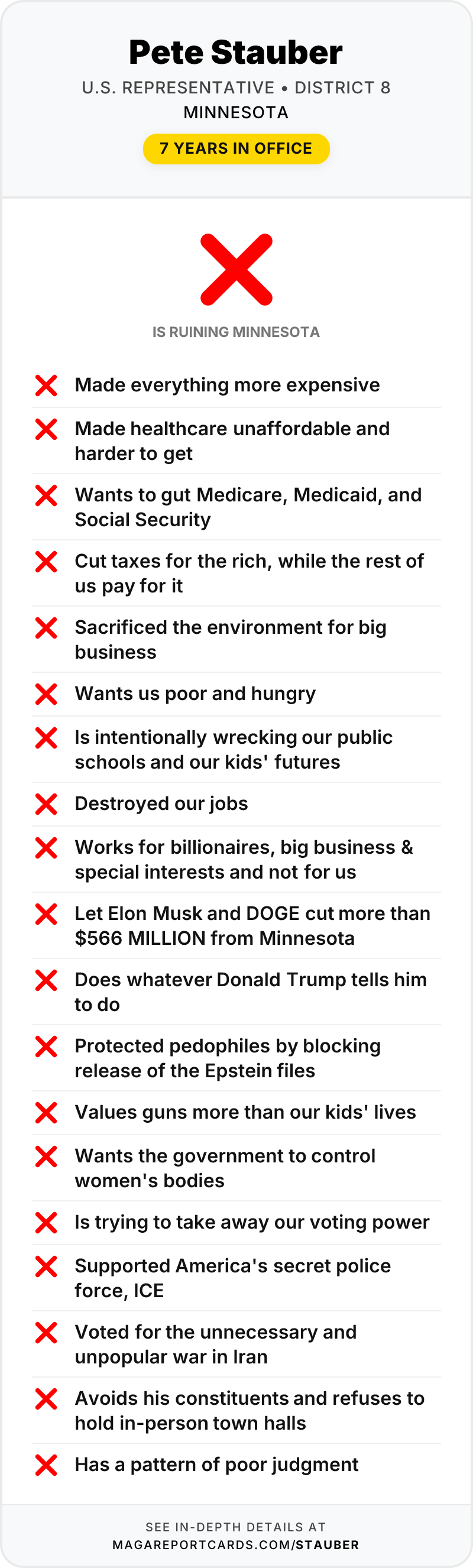
None of this is out of character. Stauber chairs the House Energy and Mineral Resources Subcommittee — meaning he writes the rules for the very industries that fund his campaigns. His top donors include Koch Inc, Nippon Steel, and Valero Energy. He has a 3% score from the League of Conservation Voters for 2025, and an 8% lifetime score. When it comes to protecting Minnesota's environment, that record speaks for itself.
And on the things that make life more expensive for the people back home, Stauber has been just as unhelpful. He voted for Trump's budget bill that, together with expiring Affordable Care Act tax credits, is projected to strip health coverage from 17,000 people in his own district — 13,767 of them on Medicaid, and he cheered on Trump's tariffs even as Minnesota farmers feared what they would cost them. When hundreds of constituents gathered outside his Hermantown office in 2025, they were asking for the basics: "he should at least come and talk to us and listen to us."
The bottom line
The Boundary Waters can't be un-polluted once it's ruined. Pete Stauber traded a permanent risk to a priceless Minnesota treasure for a foreign mining company's payday — and may have weakened public-lands protections everywhere in the process. The people of Minnesota's 8th District deserve a representative who protects what makes their home special, not one who auctions it off.
Source
This post is based on Stateline's report on the fallout from the Boundary Waters mining vote and KAXE's coverage of the Senate vote.